+251.911.231985
info@heimattoursethiopia.com

- Destinations
- Travel Style
- Ethiopia
- Heimat Exports
- About Us
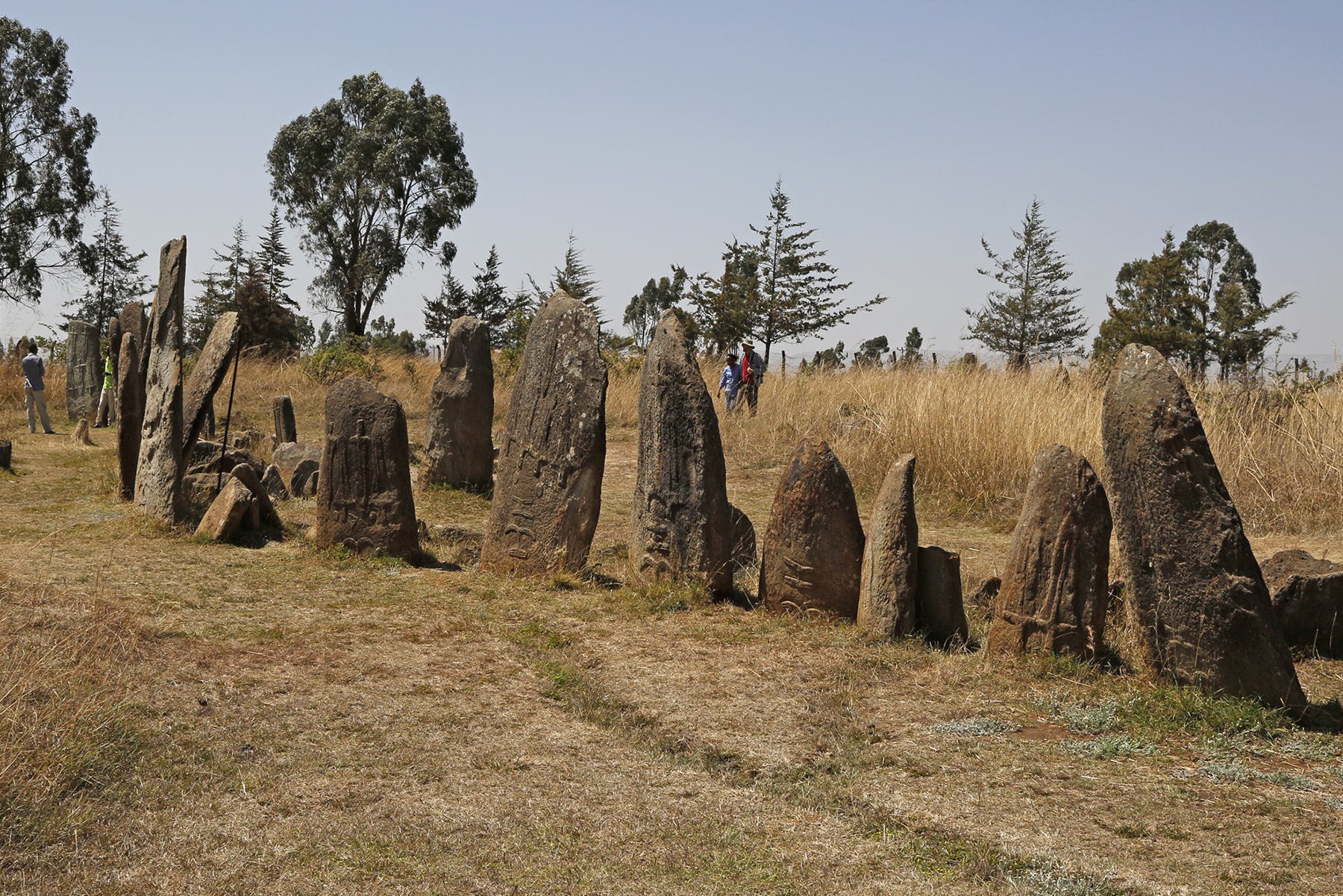
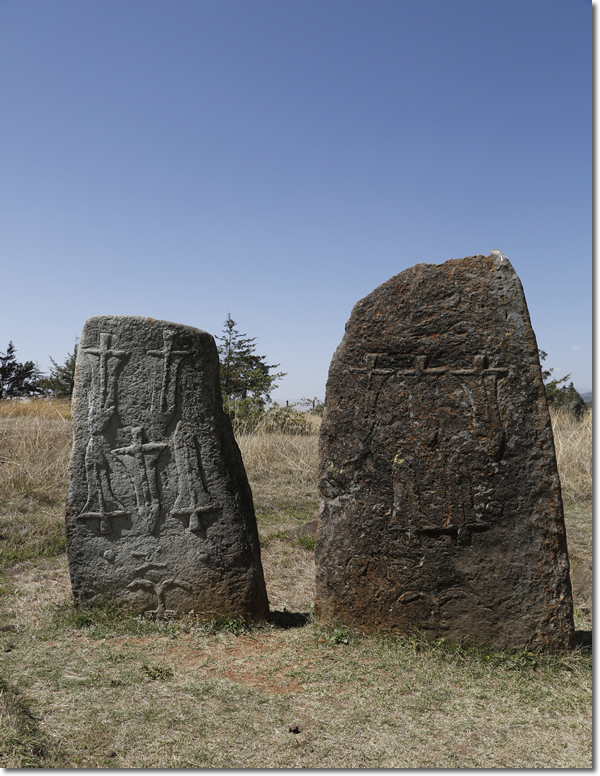 Tiya marks the northern limit of a belt of mysterious engraved stelae that stretches across southern Ethiopia through Dilla (on the Moyale road) to Negele Borena. Remarkably little is known about the origin of these stelae, or of the meaning of the symbols that are carved upon them. Recent excavations at Tiya revealed that the stones mark the mass graves of males and females who died when they were between 18 and 30 years of age, and who were laid to rest in a foetal position about 700 years ago. The presence of several engraved swords on the stele suggests that the people buried were soldiers, but this evidence is far from conclusive.
Listed as a UNESCO World Heritage Site, the stele field at Tiya today comprises some 45 stones of up to 2m in height, several of which had collapsed prior to their careful re-erection in their original positions by a team of French archaeologists of the past decade. The largest stele in the field originally stood 5m high, but only the base remains in situ – the top part has been removed to the university in Addis Ababa. Nearly all the stones are engraved. Apart from the styliseds words, the number of which is thought to represent the number of people killed by the warrior it commemorates, two other symbols predominate: plain circles, and what looks like a pair of podgy leaves rising on a stem from a rectangular base. All three symbols were present on one stone, the circles were generally near the top, the swords in the middle and the twin leaves close to the base. The plain circles appear on about one in ten stones,
and seem to denote that a female is buried underneath. The pairs of leaves look like the enset (false banana) plantain that is still widely grown in southern Ethiopia. On some stones you’ll see what looks like a Greek ‘E’, a symbol for which no plausible interpretation has been thought up. They were erected more recently than their more easterly counterparts, probably between the late 12th century and the early 14th.